Study Tips for the CSE Analytical Ability

Updated July 6, 2026
Analytical Ability is where most Professional takers lose points, and it is the most trainable section once you learn to read the structure of each question. Here is what it covers and how to study it.
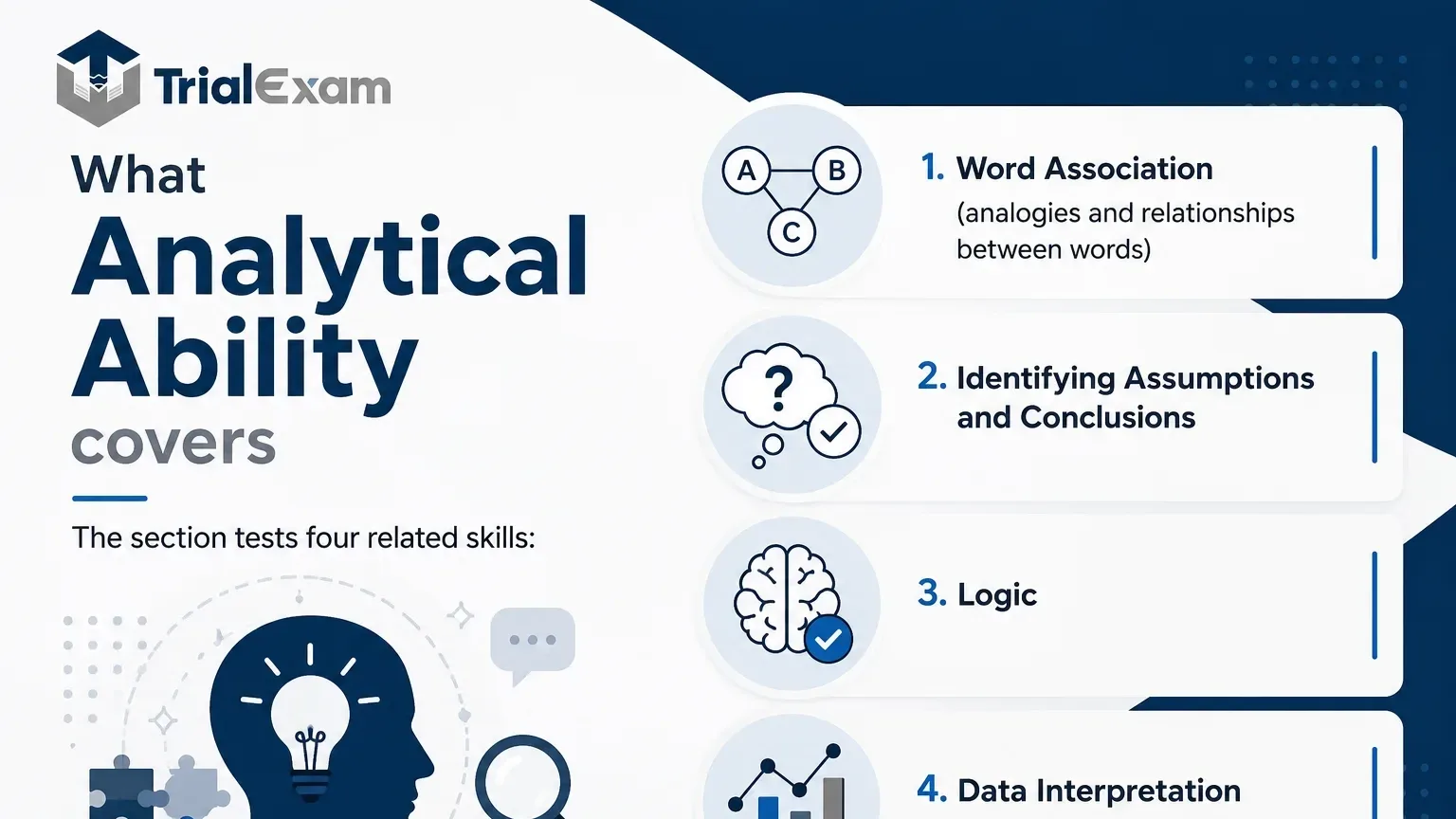
If you are taking the Professional level, Analytical Ability deserves extra attention. It is the part that Subprofessional takers never see, and it is also where a large share of Professional takers lose the points that cost them the passing mark. The good news: analytical reasoning is highly trainable. Once you learn to name the structure of a question, the answer often becomes obvious.What Analytical Ability coversThe section tests four related skills:Word Association (analogies and relationships between words)Identifying Assumptions and ConclusionsLogicData InterpretationWord Association: name the relationshipAnalogy items ask you to find a pair of words that share the same relationship as a given pair. The trick is to state the relationship in a full sentence before you look at the choices.Example: "Author is to Book as Composer is to ?" The relationship is "creator to creation," so the answer is something like "Symphony." Common relationship types include synonym, antonym, part to whole, cause and effect, and function. Learn to spot which one you are dealing with, and the matching pair stands out.Assumptions and Conclusions: separate stated from unstatedHere you have to tell the difference between what a statement actually says and what it quietly takes for granted. For assumptions, ask: "What has to be true for this argument to make sense?" For conclusions, ask: "What must follow if these statements are true?" Practice underlining the premises and the conclusion separately so you stop mixing them up.Logic: watch the absolutesLogic items often use conditional statements (if-then) and quantity words like "all," "some," and "none." These are where the traps live. "All A are B" does not mean "all B are A." When a chain of statements gets confusing, draw it out with simple arrows or circles. A quick diagram beats trying to hold everything in your head.Data Interpretation: answer only what is askedYou will get tables, charts, and graphs followed by questions. Read the title, the labels, and the units first. Then answer exactly what is asked, nothing more. Many takers lose points by computing the wrong value because they did not slow down to read the question. Estimate to sense-check your answer, and watch the units, especially with percentages.Build the habitAnalytical skill grows with consistent, structured practice. Do a short set of mixed items daily, and after each one, name which sub-skill it tested and why you got it right or wrong. Over a week or two, your error log will show you exactly which of the four skills is weakest, and that is where your time should go.To find that weak spot quickly, take the Analytical Ability mock exam on Trial Exam. It breaks your performance down by skill and measures it against the passing mark, so you can train the part that is actually holding you back instead of guessing.
Sign up for our newsletter
Get study tips, exam guides, and Civil Service updates straight to your inbox.
Ready to pass the Civil Service Exam?
Start your FREE Full Access — thousands of exam-style questions, timed mock exams, and analytics that show you exactly what to review.
Start Free Access