Study Tips for the CSE Numerical Ability

Updated July 6, 2026
Strong numerical scores are built during review, not on test day. Here is how to diagnose your weak spots, rebuild your fundamentals, and practice without a calculator before the CSE Numerical Ability section.
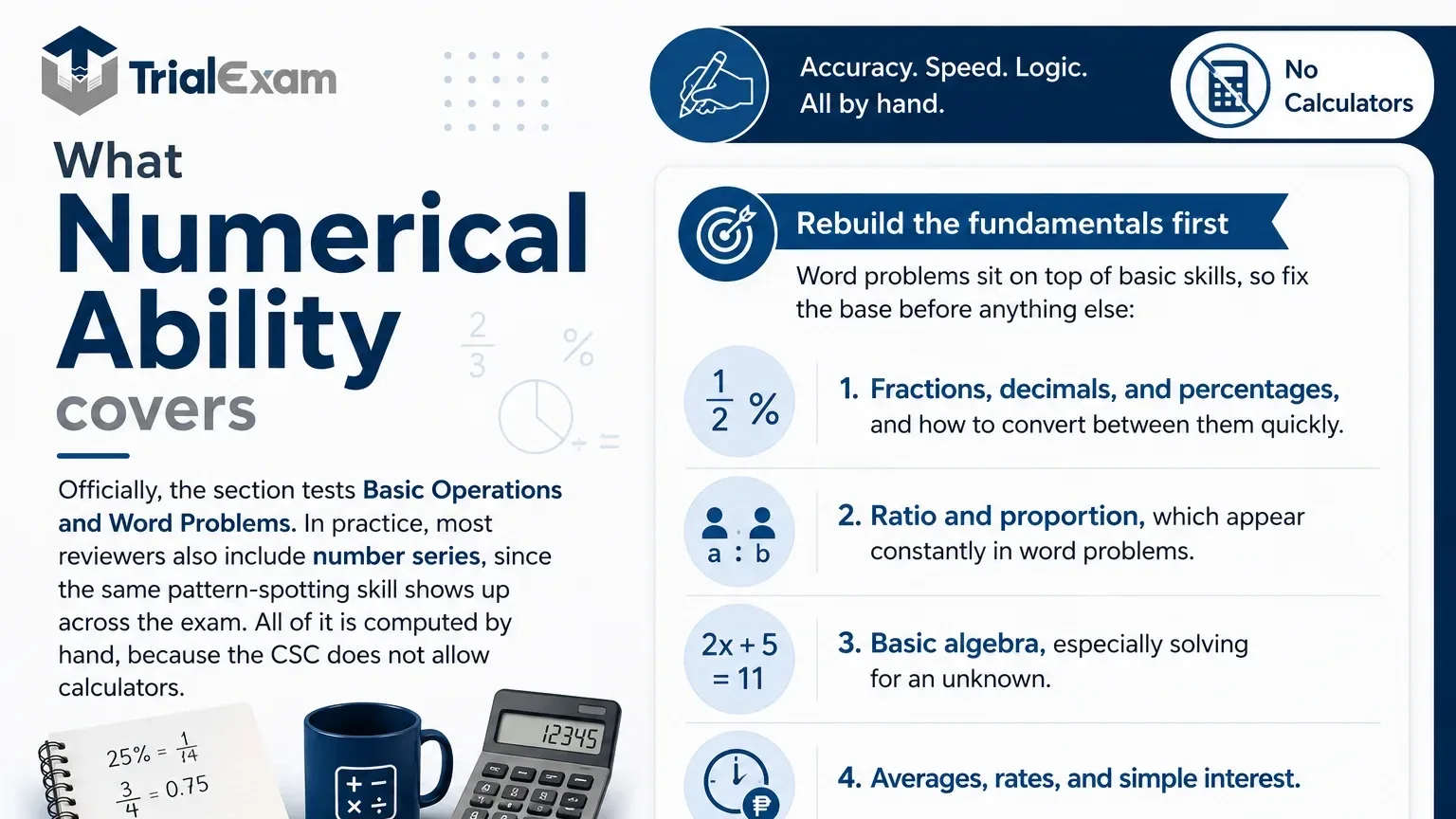
This post is about how to build your numerical skills in the weeks before the exam. If you are looking for tactics to use during the test itself, like pacing, the two-pass method, and smart guessing, see our companion post, "How to Beat Numerical Reasoning on the Civil Service Exam." Here, the focus is preparation.What Numerical Ability coversOfficially, the section tests Basic Operations and Word Problems. In practice, most reviewers also include number series, since the same pattern-spotting skill shows up across the exam. All of it is computed by hand, because the CSC does not allow calculators.Start by diagnosing, not crammingThe most common mistake is studying every topic evenly. Take a numerical mock exam first to see exactly which areas are weak. Almost always, the problem is not "math" in general but a specific shaky foundation, usually fractions, decimals, percentages, or ratio and proportion. Find the real gap before you spend a single study hour.Rebuild the fundamentals firstWord problems sit on top of basic skills, so fix the base before anything else:Fractions, decimals, and percentages, and how to convert between them quickly.Ratio and proportion, which appear constantly in word problems.Basic algebra, especially solving for an unknown.Averages, rates, and simple interest.When these become automatic, word problems stop feeling like puzzles and start feeling like translation.Practice without a calculator from day oneSince none is allowed in the exam, do not lean on one while reviewing. Build your mental math and longhand speed early: multiplication tables, the 10 percent shortcut, and common fraction-to-percent conversions. The sooner you drop the calculator, the more natural manual computation feels by August.Short daily drills beat weekend marathonsFifteen to twenty focused minutes a day builds speed and recall far better than one long cram session a week. Spread your practice out, and rotate through your weak topics rather than repeating what you already know.Keep an error logAfter each practice set, write down not just which items you missed but what kind of mistake it was: a concept you forgot, a careless slip, or a misread question. After a week, the pattern is usually obvious, and it tells you exactly what to drill next.Track your trendTake a fresh numerical mock every week or so and watch the score move. Visible progress is motivating, and a flat score is an early warning that your current approach needs to change.When you are ready to diagnose your starting point, take the Numerical Ability mock exam on Trial Exam. It shows your score against the passing mark and pinpoints the topics costing you the most, so your review aims straight at them.
Sign up for our newsletter
Get study tips, exam guides, and Civil Service updates straight to your inbox.
Ready to pass the Civil Service Exam?
Start your FREE Full Access — thousands of exam-style questions, timed mock exams, and analytics that show you exactly what to review.
Start Free Access