Study Tips for the CSE Verbal Ability

Updated June 19, 2026
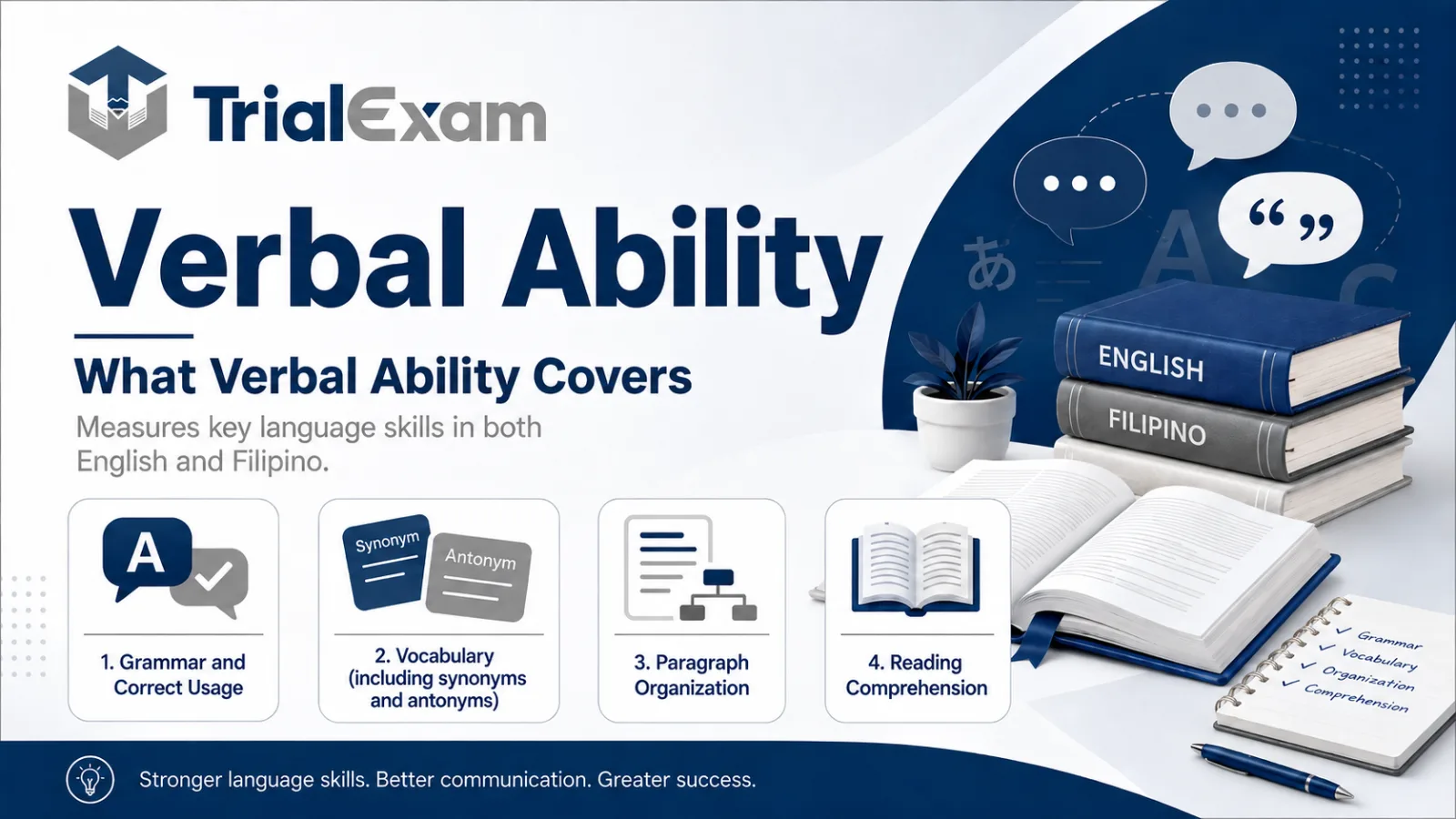
The CSE Verbal Ability is tested in both English and Filipino, which trips up takers who only review in English. Here is what it covers and how to build each skill before exam day.
Verbal Ability is one of the most learnable parts of the Civil Service Exam, but it hides a trap that costs careful takers points every cycle: the questions come in both English and Filipino. If you only review in English, you are leaving the Filipino items to chance.Here is what the section actually tests, and how to build each skill in the weeks before exam day.What Verbal Ability coversThe section measures four things, in both English and Filipino:Grammar and Correct UsageVocabulary (including synonyms and antonyms)Paragraph OrganizationReading ComprehensionKnowing the four parts lets you aim your review instead of vaguely "studying English."Vocabulary: read widely, log relentlesslyYou cannot cram thousands of words the night before. You build vocabulary by exposure. Read something every day in both languages: news articles, editorials, essays. When you meet a word you do not know, write it down with its meaning and one example sentence. Study synonyms and antonyms in pairs, since the exam often tests them that way. Learning common roots, prefixes, and suffixes also lets you decode unfamiliar words on the spot.Grammar: drill the high-frequency rulesYou do not need every rule in the book. A handful show up constantly: subject-verb agreement, verb tenses, pronoun agreement, prepositions, and misplaced modifiers. For Filipino, focus on correct usage and common affixes. The fastest way to improve is to practice error-identification and sentence-correction items, then review why each correct answer is correct.Example: "Each of the applicants (have / has) submitted their form." The subject is "each," which is singular, so the answer is "has." Spotting the real subject is half the battle.Paragraph Organization: find the anchorThese items give you jumbled sentences to arrange into a logical paragraph. Look for the topic sentence first, since it usually introduces the main idea and rarely starts with a connector. Then follow the signal words: "first," "however," "as a result," "finally." They tell you the order. Practice with short sets until the logic becomes quick to see.Reading Comprehension: read with a strategyDo not read passively. Skim the questions first so you know what to look for, then read for the main idea and structure. Answer based only on the passage, not on your outside opinions. Watch for tricky wording like "EXCEPT" or "NOT," which flips what the question is asking. Practice timed passages so you can read accurately at exam pace.Build the habitTwenty to thirty focused minutes a day beats one long weekend session. Read in both languages, do a short set of practice items, and review every wrong answer until you understand the rule behind it.When you want to measure where you stand, take the Verbal Ability mock exam on Trial Exam. It shows your score against the passing mark and flags which of the four skills is dragging you down, so your next study session has a target.
Sign up for our newsletter
Get study tips, exam guides, and Civil Service updates straight to your inbox.
Ready to pass the Civil Service Exam?
Start your FREE Full Access — thousands of exam-style questions, timed mock exams, and analytics that show you exactly what to review.
Start Free Access