How Many Hours Should You Study for the Civil Service Exam?

Updated June 19, 2026
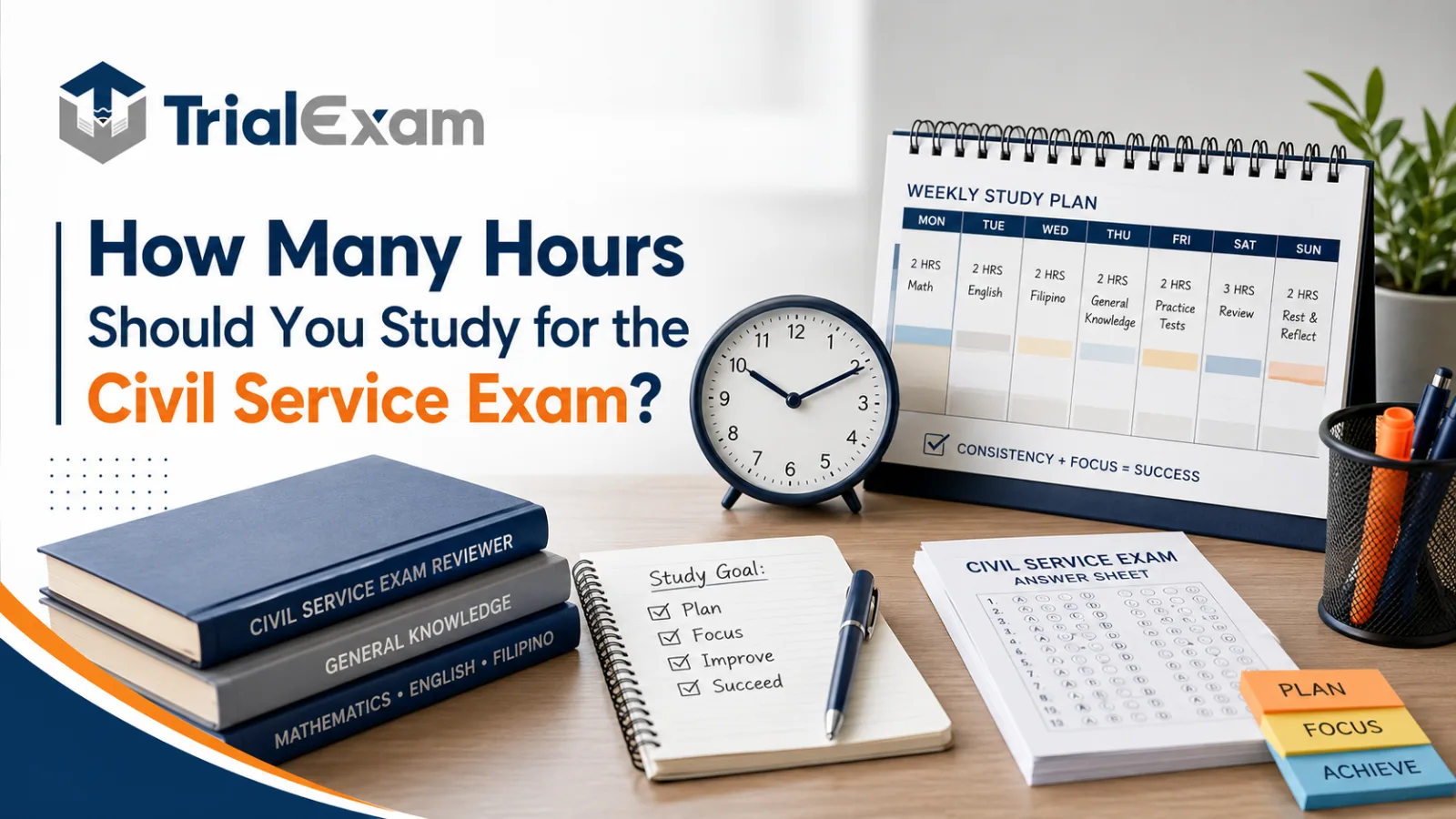
Discover how many hours you should study for the Civil Service Exam and learn practical strategies to maximize your review time and improve your chances of passing.
One of the most common questions asked by Civil Service Exam (CSE) takers is: "How many hours should I study to pass the Civil Service Exam?"The honest answer may surprise you.There is no magic number of study hours that guarantees success. Some people pass after a few weeks, while others need several months. What matters most is not how long you study, but how effectively you use your time, and whether your plan targets the right areas.In this guide, we will cover realistic study schedules, how to find your actual weak areas with a mock exam, and how to turn those results into a personalized study plan that makes every session count.Quality Over QuantityMany examinees believe they need to study 8 to 10 hours every day. In reality, studying for long stretches without focus is often less effective than shorter, structured sessions.For example:2 hours of focused study can be more productive than 6 hours of distracted reviewing.Consistent daily practice usually beats occasional marathon study sessions.The goal is to study smart, not just study hard. And studying smart starts with knowing exactly what to study.Recommended Study Hours Based on Your SituationIf You Have 3 Months Before the ExamA comfortable review schedule might be:1 to 2 hours per day5 to 6 days per weekThis gives you enough time to cover all four exam parts while avoiding burnout.If You Have 1 Month Before the ExamYou may need to increase your study time to:2 to 4 hours per dayFocus on your weakest areasInclude regular mock examsConsistency matters even more when time is limited.If You Are a Working ProfessionalMany successful examinees have full-time jobs. A practical schedule could be:1 hour before or after workExtra review time on weekendsEven small daily sessions add up to real improvement over time.Hours Are Only Half the Story: Study the Right ThingsHere is the trap most reviewers fall into. They pour hours into the subjects they already enjoy and quietly avoid the ones they struggle with. You can study 4 hours a day and still walk into the exam weak in the exact part that pulls your score below passing.The fix is simple. Before you build a schedule, find out where you actually stand. The fastest way to do that is to take a full mock exam and look at your results part by part.Step 1: Take a Diagnostic Mock ExamA diagnostic mock exam shows you your real starting point across the four CSE parts: Verbal, Analytical, Numerical, and General Information.You can do this for free. Trial Exam has a free Mock Exam, and when you finish, you get a Performance Overview that breaks your score down by part. Instead of guessing, you see something like this:Verbal: 85%Analytical: 67%Numerical: 58%General Information: 74%Please register and try our Mock Exam here:👉I want to know my Performance OverviewRight away, the picture is clear. Numerical is dragging your score down, and Analytical needs work too. Trial Exam even surfaces this for you with a "Focus on" prompt that points to your biggest opportunity for improvement, so you are not left interpreting the numbers alone.This is the difference between studying blind and studying with a map.Step 2: Turn Your Results Into a Personalized Study PlanOnce you know your weak areas, you can stop following a generic one-size-fits-all schedule and start building a plan around your own results.This is where Trial Exam's Study Plan comes in. It takes your mock exam performance and turns it into a guided plan, automatically:Smart study goals. The system generates goals based on your weak areas and the categories where you are close to leveling up, so you always know what to work on next.A 6-tier progress system. Each part moves through six levels: Newbie, Starter, Reviewer, Achiever, Expert, and Master. You advance based on both how many questions you answer and how accurate you are, so you cannot fake progress.A recommended next exam. Instead of wondering what to take next, the plan suggests your next Full Mock or Mini Mock based on where you currently stand.A weekly activity calendar. A simple 7-day view that tracks your study streak and helps you stay consistent.A category progress tracker. See your tier badge, question count, and accuracy for every part in one place.In short, your results write your study plan for you. The more you practice, the more the plan adjusts to keep pointing you at what will raise your score the fastest.A quick note on scoring: Trial Exam uses its own style weighted scoring to help you gauge your readiness and pinpoint weak areas. Your Trial Exam score is a study guide to track your progress, not a guarantee or a prediction of your official CSC result.What Should You Study? A Look at the Four PartsYour mock results tell you which of these to prioritize first, but here is what each part covers.Verbal AbilityFocus on:GrammarVocabularyReading comprehensionSentence structureStudy Tips for CSE Verbal AbilityNumerical AbilityPractice:PercentagesFractionsRatio and proportionWord problemsBasic algebraStudy Tips for Numerical AbilityAnalytical AbilityDevelop skills in:Logical reasoningProblem-solvingData interpretationStudy Tips for Analytical AbilityGeneral InformationStay updated on the following:Philippine ConstitutionGovernment programsCurrent eventsPhilippine historyEnvironmental issuesWhy Practice Exams MatterMany examinees spend all their time reading reviewers but rarely answer practice questions. This is a mistake.Practice exams help you:Apply what you have learnedImprove your time managementIdentify weak areasBuild confidenceSimulate actual exam conditionsA balanced review plan includes both studying and testing yourself. With Trial Exam you can switch between two modes:Practice mode. Answer a question, then see the correct answer and a full explanation right away. This is your learning mode.Timed mode. A full exam simulation with the clock running and no answers shown until you finish. This is your test-yourself mode.Practice mode is for learning. Timed mode is for checking whether you are ready.A Sample Weekly Study Plan (Then Personalize It)Here is a simple starting template. Use your mock results to decide which days to expand.Monday: Verbal AbilityTuesday: Numerical AbilityWednesday: Analytical AbilityThursday: General InformationFriday: Review weak areas (the parts your mock exam flagged)Saturday: Take a mock examSunday: Review your mistakes and restNotice that this template treats every part equally. Your personalized plan should not. If Numerical is your weakest part, give it two days instead of one, and pull time from the parts where you already score high.Signs You Are Studying EffectivelyYou do not need to count every hour if you are seeing real progress. Good signs include:Higher scores on practice testsFaster problem-solving speedBetter understanding of conceptsIncreased confidenceImproved time managementThese indicators matter more than the total number of study hours. Trial Exam's score trend chart makes this easy to see, since it plots your scores over time against the passing line.Avoid These Common Study MistakesCramming. Trying to learn everything in the final days usually leads to stress and poor retention.Studying without a plan. Random reviewing leaves important topics uncovered. A results-based plan fixes this.Ignoring weak areas. Focusing only on easy subjects limits your improvement. This is the single most common reason capable reviewers fail.Skipping mock exams. Practice exams are how you measure readiness. Without them, you are guessing.The Best Study Plan Is the One Built Around Your ResultsThe ideal number of study hours depends on your schedule, your learning style, and your current level. What matters most is consistency and direction.Studying one focused hour every day, aimed at your real weak areas, beats studying ten unfocused hours on weekends. The reviewers who pass are not always the ones who study the longest. They are the ones who know exactly what to study next.If you want a study plan that builds itself around your results, start with the free Demo Exam at trial-exam.com. See your weak areas, let the Study Plan set your goals, and track your progress all the way to the August 9, 2026 exam. Full Review access is 399 pesos, with no confusing tiers.Frequently Asked QuestionsHow many hours a day should I study for the Civil Service Exam? There is no fixed number. With 3 months to prepare, 1 to 2 focused hours a day, 5 to 6 days a week is a comfortable pace. With 1 month left, aim for 2 to 4 hours a day. Consistency and focusing on your weak areas matter more than total hours.How do I know which CSE part to focus on? Take a mock exam and review your score by part. A diagnostic like Trial Exam's free Mock Exam breaks down your performance across Verbal, Analytical, Numerical, and General Information, so you can see which part is lowest and start there.Do I really need a study plan to pass the CSE? A plan is not required, but it dramatically improves your odds. A plan built around your actual weak areas keeps you from wasting time on subjects you have already mastered.Goodluck on your CSE Journey!
Sign up for our newsletter
Get study tips, exam guides, and Civil Service updates straight to your inbox.
Ready to pass the Civil Service Exam?
Start your FREE Full Access — thousands of exam-style questions, timed mock exams, and analytics that show you exactly what to review.
Start Free Access