Your Complete CSE Exam Day Guide: What to Bring, What to Wear, and What to Expect

Updated July 6, 2026
Months of review can come undone by a small exam-day mistake. Here is everything you need to walk in ready: what time to arrive, the dress code, what to bring (black ball pens only), and what to leave at home.
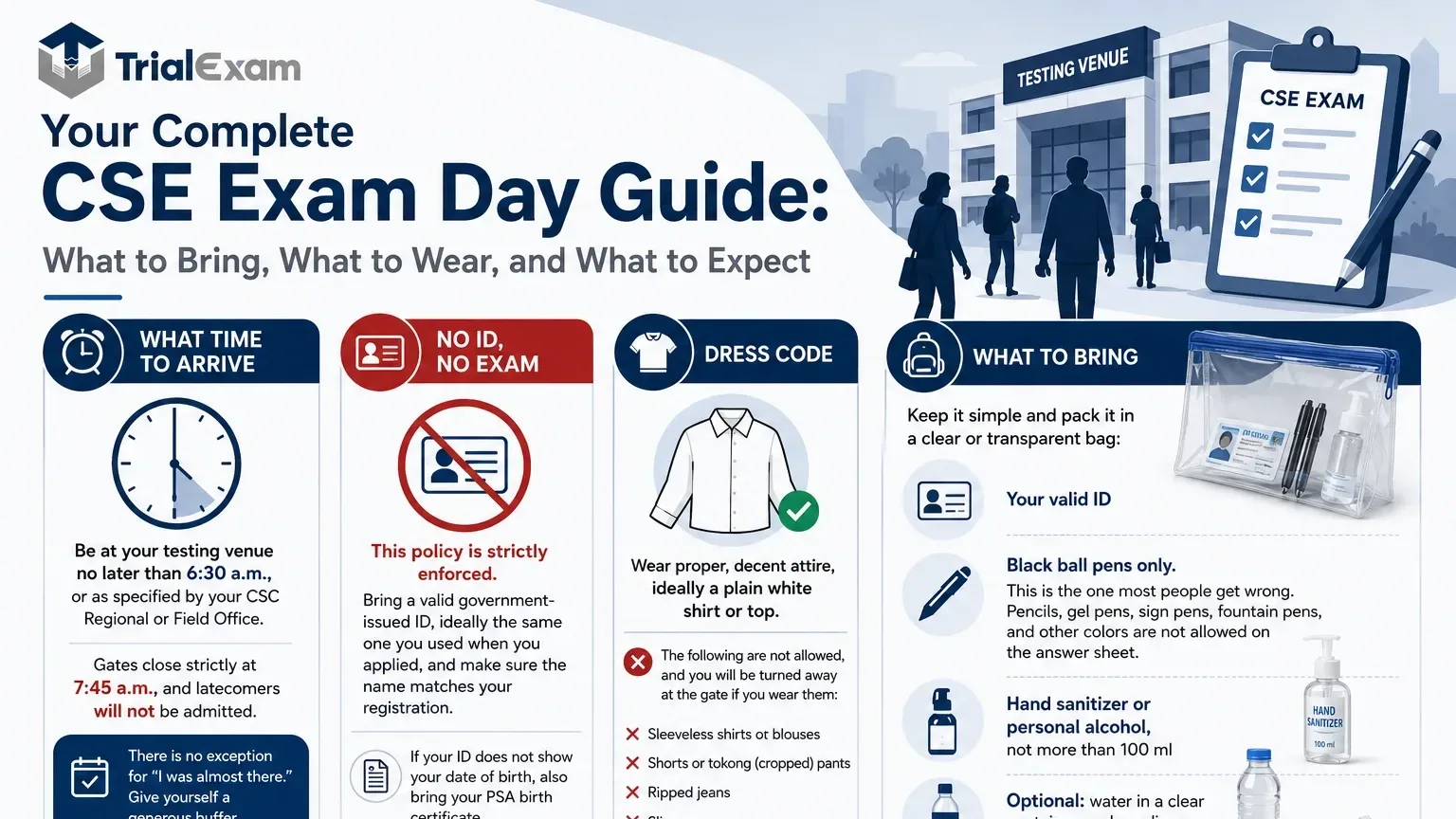
Months of review can come undone by a small exam-day mistake: the wrong pen, the wrong outfit, or arriving five minutes too late. The good news is that none of these are hard to avoid once you know the rules. Here is everything you need to walk in calm and ready on the day of your Civil Service Exam.A few days beforeTwo things to do before exam day arrives:Find your testing venue. Check the Online Notice of School Assignment (ONSA) on csc.gov.ph to see where you have been assigned. Do not assume it is the nearest school.Read your Examinee's Guide. The CSC emails this roughly a week before the exam, and it contains the official rules for your specific schedule. Read it fully.If you can, visit your testing venue the day before to learn the route and how long the trip takes. On exam morning, traffic is the last thing you want to gamble on.What time to arriveBe at your testing venue no later than 6:30 a.m., or as specified by your CSC Regional or Field Office. Gates close strictly at 7:45 a.m., and latecomers will not be admitted. There is no exception for "I was almost there." Give yourself a generous buffer.No ID, No ExamThis policy is strictly enforced. Bring a valid government-issued ID, ideally the same one you used when you applied, and make sure the name matches your registration. If your ID does not show your date of birth, also bring your PSA birth certificate.Dress codeWear proper, decent attire, ideally a plain white shirt or top. The following are not allowed, and you will be turned away at the gate if you wear them:Sleeveless shirts or blousesShorts or tokong (cropped) pantsRipped jeansSlippersWhat to bringKeep it simple and pack it in a clear or transparent bag:Your valid IDBlack ball pens only. This is the one most people get wrong. Pencils, gel pens, sign pens, fountain pens, and other colors are not allowed on the answer sheet.Hand sanitizer or personal alcohol, not more than 100 mlOptional: water in a clear container, and candies or biscuits (the proctor may inspect these)What to leave at homeThe CSC strictly prohibits anything that could be used as an aid or a communication device. Do not bring these to your seat:Cellphones, smartphones, smartwatches, and tabletsCalculators of any kind, including watch calculatorsBooks, dictionaries, notes, and other printed materialsEyeglasses or pens with built-in camerasBags and other personal belongings (these are deposited in a designated area, not kept at your seat)Two more rules worth remembering: do not take photos or post any test content online, and never bring the test booklet out of the room. Both can get your results cancelled.What the exam itself looks likeThe Professional level has 170 items and runs 3 hours and 10 minutes. The Subprofessional level has 165 items in 2 hours and 40 minutes. Questions appear in both English and Filipino, and since no calculator is allowed, every computation is done by hand. You need a general rating of 80% to pass.A quick tactical reminder: there is no penalty for wrong answers, so never leave an item blank. If time runs short, eliminate what you can and make your best guess. (For the full numerical strategy, see our post "How to Beat Numerical Reasoning on the Civil Service Exam.")After the examResults are posted as a list of passers on csc.gov.ph, and you can generate your individual rating through the Online Civil Service Examination Result Generation System (OCSERGS). Ratings are usually released within about 60 days. Passers earn Career Service eligibility, which you will use when applying for government positions.Walk in already familiarMost exam-day nerves come from facing an unfamiliar format under pressure. The fix is to make the format boring before you ever sit down. Take a few full-length mock exams on Trial Exam under real conditions, timed and without a calculator, so that on August 9 the only new thing in the room is the questions. Prepare the logistics early, practice the way you will be tested, and let exam day be the easy part.
Sign up for our newsletter
Get study tips, exam guides, and Civil Service updates straight to your inbox.
Ready to pass the Civil Service Exam?
Start your FREE Full Access — thousands of exam-style questions, timed mock exams, and analytics that show you exactly what to review.
Start Free Access